
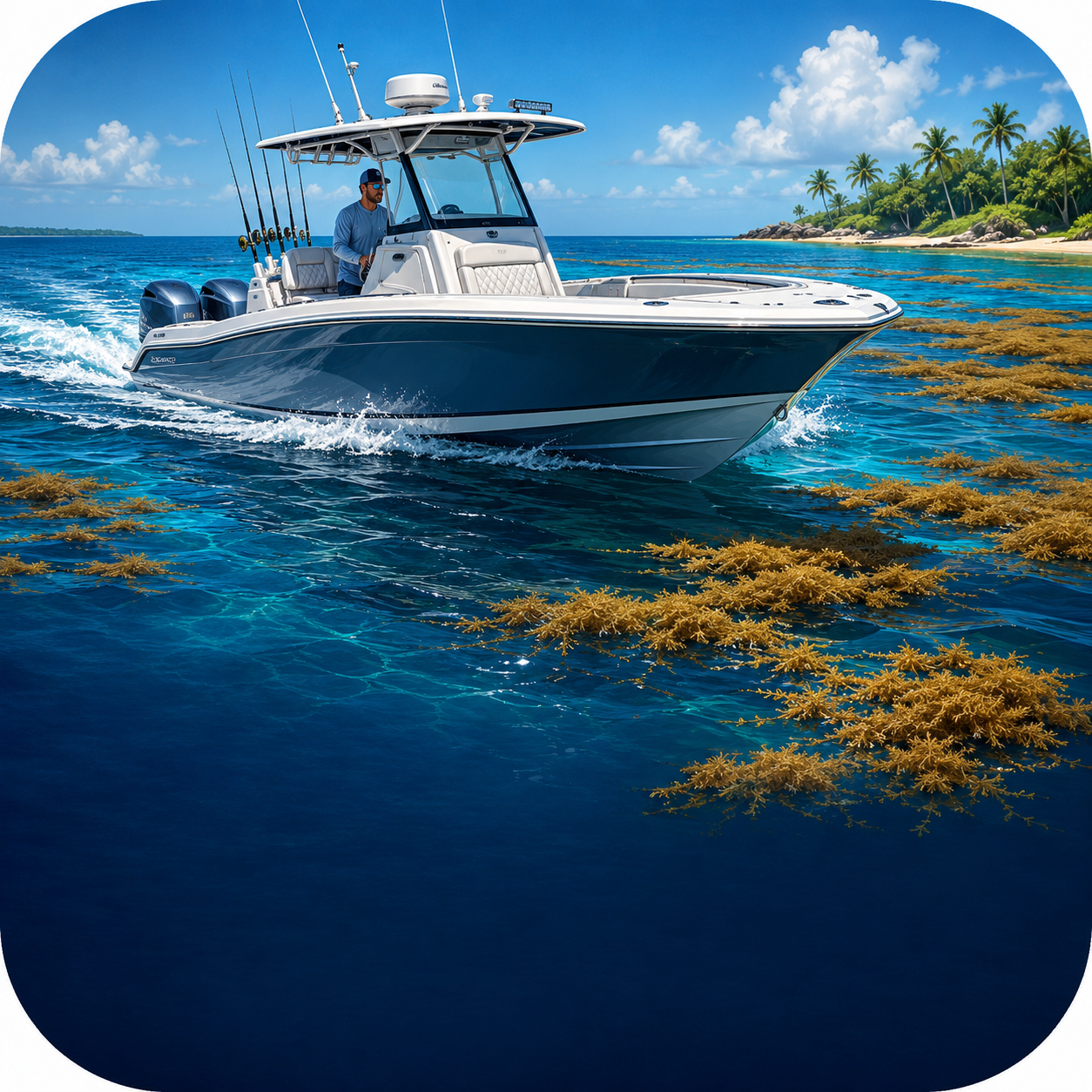
How Sargassum Can Damage Your Boat — and the Precautions Every Boater Should Take
If you boat regularly in South Florida, the Keys, the Bahamas, Mexico, Turks and Caicos, or the Caribbean, chances are you have already encountered heavy patches of sargassum.
At first glance, sargassum may look like a floating nuisance. But for boats, it can become a serious maintenance issue.
The biggest problem is simple: sargassum can block water flow.
Most boats depend on clean raw-water circulation to cool engines, generators, air conditioning systems, refrigeration systems, and other onboard equipment. When floating algae is pulled toward intakes, strainers, lower units, or grates, cooling-water flow can quickly become restricted.
That restriction can lead to:
Engine overheating
Generator shutdowns
Burned or damaged impellers
Blocked sea strainers
Air conditioning failures
Exhaust temperature alarms
Reduced cooling efficiency
Increased wear on pumps and cooling components
Unpleasant odors around the boat when algae decomposes
Sargassum does not affect every boat the same way. The risk depends heavily on whether the boat uses outboards, inboards, generators, or multiple raw-water systems.
Below is a practical guide separated by boat type and system.
Why Sargassum Is a Problem for Boats
Sargassum becomes most dangerous when it accumulates around areas where your boat pulls in water.
This can happen while:
Idling in a marina or canal
Running slowly through floating patches
Anchoring overnight in calm water
Sitting near a shoreline where algae collects
Entering a harbor with poor circulation
Running a generator or air conditioning system while anchored
Even a partial blockage can reduce cooling-water flow enough to raise operating temperatures. In more serious cases, water flow can stop almost completely.
This can affect:
Engine water pumps
Rubber impellers
Heat exchangers
Exhaust hoses
Turbochargers
Generator raw-water systems
Air conditioning pumps
Refrigeration pumps
Watermakers
For general water-management equipment, you can browse the Pumps Collection at marinegear.shop, which includes bilge pumps and related accessories for different boat sizes and layouts.
Sargassum Precautions for Boats with Outboards
Outboard boats are especially exposed because the water pickups are located on the lower units, close to where floating weed and debris can pass under the boat.
This is common on center consoles, fishing boats, tenders, bay boats, and smaller cruising boats.
Common Outboard Problems Caused by Sargassum
Heavy sargassum can:
Block cooling-water intakes
Reduce or stop the telltale water stream
Trigger engine overheating alarms
Damage water pump impellers
Restrict exhaust-water flow
Reduce performance at higher RPMs
Cause engines to go into protection mode
Twin, triple, and quad outboard boats can also pull a large amount of water at the same time, which may draw floating weed toward multiple lower units simultaneously.
Precautions for Outboard Boats
1. Avoid Dense Patches When Possible
If you can safely route around heavy sargassum, do it.
A small detour is much cheaper than replacing an impeller or dealing with an overheated engine offshore.
2. Watch the Telltale Water Stream
The telltale stream is one of your first warning signs.
If the stream becomes weak, inconsistent, or stops:
Reduce RPM immediately
Shift to neutral if safe
Watch the temperature gauge
Shut down if the engine continues to heat up
Inspect the intake area before continuing
3. Do Not Ignore Temperature Alarms
If an outboard gives you an overheating warning after crossing sargassum, treat it seriously.
Running just a little longer can turn a simple cooling restriction into a damaged impeller, melted housing, or more expensive engine repair.
4. Flush the Engines After Use
After boating through sargassum-heavy areas:
Flush engines thoroughly with fresh water
Inspect lower-unit intakes
Confirm normal water flow
Check for pieces of algae trapped around pickups
5. Keep the Bilge Ready Too
Sargassum itself is mainly a cooling-water problem, but heavy weed conditions often come with rougher water, spray, rain, washdown, and debris around the boat.
For smaller outboard boats, compact bilge pumps like the Whale Supersub 500 GPH Bilge Pump 12v can be useful for tight bilge spaces. For center consoles or day boats that need more capacity, the Attwood Sahara MK2 S800 12vDC 5 Amp Bilge Pump is another practical option to consider.
Sargassum Precautions for Boats with Inboards
Inboard boats and larger yachts face a different type of risk.
Instead of pulling water through an outboard lower unit, they usually rely on raw-water intakes under the hull. These intakes feed the engines and often several other onboard systems.
On many inboard boats, raw water may be used for:
Main engines
Transmissions
Generators
Air conditioning
Refrigeration
Watermakers
Stabilizers
Livewells
Once a sea strainer or intake scoop begins to clog, multiple systems can be affected.
Common Inboard Problems Caused by Sargassum
Heavy sargassum can cause:
Engine overheating
Exhaust temperature alarms
Restricted seawater flow
Blocked strainers
Burned raw-water impellers
Reduced cooling through heat exchangers
A/C shutdowns
Generator problems while anchored
On larger yachts, the problem may develop gradually. The engine may continue running, but temperature may slowly creep above normal.
That is why visual checks and gauge monitoring are so important.
Precautions for Inboard Boats
1. Inspect Sea Strainers More Often Than Usual
During heavy sargassum conditions, strainers may need to be checked several times in one day.
When inspecting strainers:
Shut the seacock before opening the strainer
Clean the basket completely
Check the gasket or O-ring
Reinstall the lid properly
Reopen the seacock
Confirm strong water flow after restart
Never open a raw-water strainer without closing the seacock first.
2. Watch Engine Temperature Closely
Do not wait for the alarm.
If your engine normally runs at a steady temperature and suddenly begins running hotter after passing through floating weed, assume you may have reduced water flow.
3. Check Exhaust Water Discharge
Reduced exhaust-water flow is a major warning sign.
If the exhaust looks weak, steamy, or different from normal, investigate immediately.
4. Slow Down in Heavy Weed
Running at high RPM through dense sargassum can pack debris into strainers and hull intakes quickly.
If you cannot avoid the area, slowing down may reduce suction and give you more time to monitor the boat.
5. Inspect Intake Scoops and Grates
Sargassum can wrap around:
Intake scoops
Hull grates
Bow thruster tunnels
Stabilizer intakes
Watermaker intakes
In severe conditions, an underwater inspection may be necessary.
6. Match Bilge Equipment to the Boat
Inboard boats usually have deeper bilges and more onboard systems, so the bilge setup should match the boat size and voltage.
For larger 12V boats, the Attwood Heavy Duty HD2000 12vDC 7 Amp Bilge Pump is a higher-capacity option. For 24V yachts, options such as the Attwood Heavy Duty HD2000 24vDC 3.5 Amp Bilge Pump or the Whale Supersub Smart 1100 GPH Bilge Pump 24v may be better suited depending on your bilge layout and electrical system.
Generator Protection During Sargassum Season
Generators are one of the systems most commonly affected by sargassum.
The reason is simple: generators often run while the boat is anchored, rafted up, or sitting in calm water where sargassum collects around the hull.
Unlike the main engines, the generator may be pulling water continuously from the same area for hours.
Common Generator Problems Caused by Sargassum
Heavy sargassum can cause:
Generator overheating
High exhaust temperature alarms
Automatic shutdowns
Burned impellers
Exhaust hose damage
Reduced onboard air conditioning
Loss of battery charging while anchored
Many generator issues begin with a clogged strainer.
Precautions for Generators
1. Check the Generator Strainer Frequently
If you are anchored in a sargassum-heavy area and running the generator, check the generator strainer often.
In severe conditions, check it every few hours.
2. Listen for Exhaust Changes
A generator that suddenly sounds different may already have restricted water flow.
Watch for:
Less water coming out of the exhaust
More steam than usual
A sharper or hotter exhaust smell
Changes in generator tone
3. Do Not Ignore A/C Problems
If the air conditioning suddenly becomes weaker while the generator is running, do not assume it is only an A/C problem.
It may be a raw-water flow problem.
Inspect the strainer, seawater pump, and generator cooling flow.
4. Reposition the Boat When Needed
If sargassum is collecting heavily against one side of the hull, repositioning the boat may help.
Wind and current direction can make a big difference.
5. Keep Spare Generator Impellers Onboard
Generator impellers are relatively small and can be damaged quickly when starved of water.
If you cruise to the Bahamas or remote areas, spare impellers should be part of your onboard maintenance kit.
6. Support Overnight Water Management
When boats sit overnight, bilge water can come from rain, washdown, condensation, spray, and minor nuisance leaks. A dry-bilge system will not prevent sargassum from clogging a raw-water intake, but it can help keep accumulated bilge water under control.
For boats that anchor frequently, the Bilge-B-Dry Single Pump 12v Dry Bilge System is a useful supporting product to consider. An automatic switch like the Attwood S3 Automatic Bilge Switch 12vDC 15 Amp can also help automate bilge pump operation when properly matched to the pump and installation.
Do Not Forget Marine Air Conditioning Systems
Many boaters focus only on engines and generators, but marine A/C systems are also highly vulnerable to restricted seawater flow.
A clogged seawater intake can cause:
Poor cooling performance
High-pressure faults
Pump strain
Compressor shutdowns
Warm cabins at anchor
If your A/C suddenly stops cooling during sargassum season, inspect the seawater strainer before assuming the air conditioning unit itself has failed.
In many cases, the problem starts with restricted water flow.
Best Practices Before, During, and After Sargassum Conditions
Before Departure
Before heading out:
Check the forecast and local sargassum reports when available
Inspect raw-water strainers
Confirm normal cooling-water flow
Verify bilge pumps are operating
Make sure float switches or automatic switches work
Carry spare impellers for engines and generator
Carry basic tools for strainer and hose inspections
During Navigation
While underway:
Avoid dense floating patches when possible
Reduce RPM if you must cross heavy weed
Watch engine temperature gauges
Watch outboard telltale streams
Monitor exhaust-water discharge
Investigate alarms immediately
Avoid running over thick mats at high speed
While Anchored
At anchor:
Inspect the area around the boat
Watch whether sargassum is collecting near intakes
Check the generator strainer periodically
Monitor A/C cooling performance
Listen for generator exhaust changes
Reposition if algae accumulates heavily around the hull
After Returning to the Dock
After boating through sargassum:
Flush outboards with fresh water
Inspect lower-unit intakes
Clean sea strainers
Rinse the bilge area if needed
Inspect bilge pumps and switches
Check for algae around grates and underwater fittings
Watch for unusual smells from decomposing organic material
Helpful Products to Consider
Sargassum prevention is mainly about protecting water flow and monitoring your systems. No bilge pump or dry-bilge system will stop sargassum from entering a raw-water intake, but the right onboard equipment can support better water management and maintenance readiness.
Helpful products include:
Always verify voltage, capacity, installation space, hose size, switch compatibility, and manufacturer recommendations before replacing or upgrading any marine pump.
Final Thoughts
Sargassum is more than a beach nuisance.
For boat owners, it can become a real mechanical and operational problem if it restricts raw-water flow.
Whether your boat has outboards, inboards, a generator, marine air conditioning, or all of the above, the main rule is the same:
Protect cooling-water flow and inspect your systems often.
A few extra checks before and after boating through sargassum can help prevent overheating, generator shutdowns, damaged impellers, and expensive repairs.
When conditions are heavy, slow down, monitor your gauges, clean your strainers, and keep your boat water-management systems ready.